Imagine a single button at the centre of the economy. It is red, and it is large, and pressing it makes money appear from nothing. No one has to be taxed. No one has to be asked. The button simply produces currency, instantly, in whatever quantity the people holding it decide. It is the most convenient instrument of power ever devised, because its costs are invisible at the moment of use and its benefits are immediate. And almost every economic affliction of the modern world can be traced, through a chain of consequences most people never follow to the end, back to the pressing of that button.
This is the diagnostic companion to The Cathedral Problem: where that issue laid out what hard money could build, this one maps what soft money destroys — the disease for which the book proposes the cure.
The Cascade
The act itself is simple: a government spends more than it raises, and the gap is ultimately filled by new money. What follows is anything but simple. The newly created currency does not distribute itself evenly. It enters at specific points, distorting the price signals that tell everyone where capital should go, raising the costs businesses face, and inflating the prices of assets — houses, stocks, land — which rewards those who already own them and pushes them out of reach for everyone else.
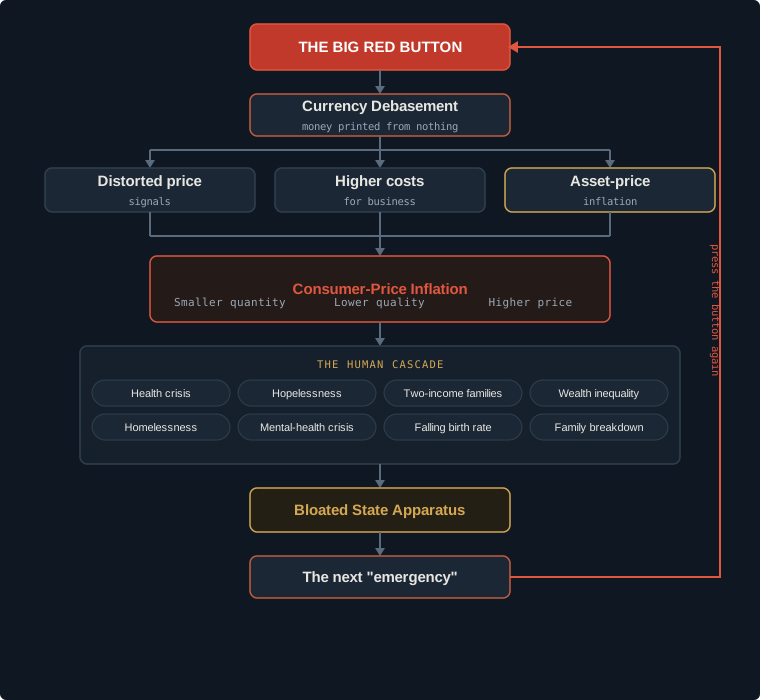
Each of those human consequences is normally treated as its own separate emergency, with its own separate experts. The claim of the diagram is that they are branches of one tree, and the root is the button. Lower quality feeds a health crisis; collapsing affordability feeds hopelessness and the need for two incomes where one once sufficed; asset inflation feeds inequality and, downstream, homelessness — and those in turn feed the tertiary row almost no one traces back to money at all: a mental-health crisis, falling birth rates, the slow breakdown of the family.
Why the Loop Tightens
Here is the part that turns a bad mechanism into a doom loop. Every one of those strains flows into the same place — a growing demand on the state to do something. The state expands to manage the damage: more spending, more intervention, more debt. And the swelling state, unable to fund all of this through taxes its citizens would tolerate, reaches again for the only frictionless instrument it has. It presses the button.
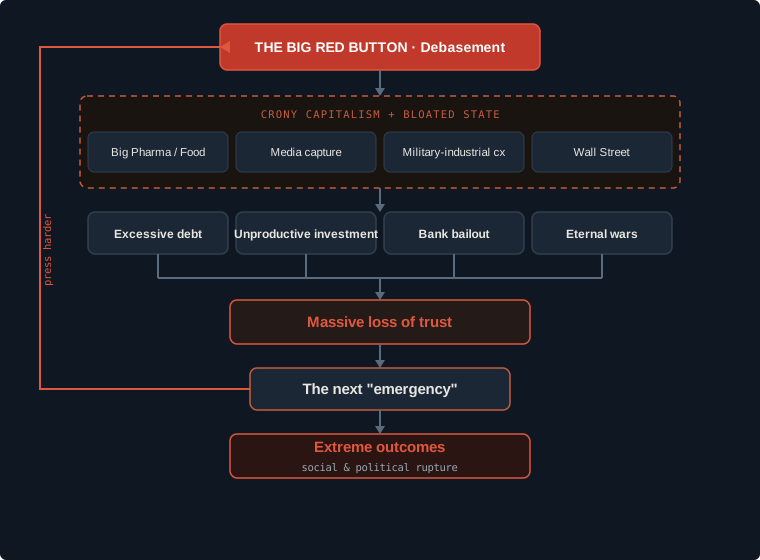
The loop is not a circle that returns to where it started. It is a spiral that widens with every turn.
Each turn of the loop produces a larger crisis than the last — and the larger crisis becomes the justification for pressing the button harder. The system does not seek equilibrium. It escalates.
What Money Is Supposed To Be
To see the way out, ask a question that sounds almost childish: what is money actually supposed to do? For thousands of years, humanity converged on a set of properties that make something good money. The clarifying exercise is to score honest, scarce money against the fiat currency we use today on each one.
| Property | Sound Money | Fiat |
|---|---|---|
| Scarce | Forever limited, instantly verifiable | The printer goes brrr — no ceiling |
| Portable | Effortless to move | Effortless to move |
| Divisible | Near-infinitely | Near-infinitely |
| Durable | Lasts without decay | Lasts without decay |
| Fungible | Each unit identical | Each unit identical |
| Acceptable | Anyone, anywhere | Anyone, anywhere |
| Censorship-resistant | You hold it — no one can confiscate it or block you | You don't hold it — your transactions can be frozen |
On five of the seven classic properties — portability, divisibility, durability, fungibility, acceptability — sound digital money and fiat are essentially tied. The two systems diverge on exactly two properties, and they are the two that matter most. Scarcity: sound money is limited forever and verifiable by anyone in seconds; fiat has no fixed ceiling. Censorship-resistance: hold sound money yourself and no one can confiscate it or block your transactions; with fiat you do not truly hold it — an intermediary does, and can freeze or reverse you. On the two properties that determine whether money is honest and whether it is truly yours, the two are opposites.
The Only Real Exit
This is where the doom loop and the properties of money meet. The loop runs on the button — on the ability to create currency from nothing. Remove that ability and the loop cannot turn. A money that is genuinely scarce cannot be printed to fund the deficit; a money you truly hold cannot be quietly debased out from under you. The entire cascade depends on a money that can be created at will. Take away the button and the machine that runs on it stops.
I don’t believe we shall ever have good money again before we take the thing out of the hands of government — we can’t take it violently out of their hands, all we can do is, by some sly, roundabout way, introduce something they can’t stop.
— F. A. Hayek
Hayek understood that you cannot vote the button away, because whoever holds it benefits from holding it, and no institution willingly surrenders the most convenient instrument of power ever built. The separation of money and state could not be legislated; it would have to be introduced — in his words — in a sly, roundabout way, as something the state could not stop. He was describing, decades before it existed, exactly what Bitcoin turned out to be: not a currency the state was persuaded to adopt, but a money released into the world beyond anyone’s ability to shut it down. (Its scarcity is anchored not in a promise but in physics.)
What It Means
The single most clarifying move in economics is to trace effects back to their cause — and the cause of an astonishing range of modern afflictions is hidden in plain sight, in a mechanism so abstract almost no one connects it to the suffering it produces. We are trained to treat unaffordable housing, wage stagnation, inequality, family breakdown, falling birth rates, crony capitalism, and endless war as distinct issues, each with its own experts. The two diagrams make a different claim: that many of them are downstream branches of a single upstream act. If that is even partly right, it reframes everything — because you cannot fix a downstream symptom with more of the money creation that is the upstream cause. The programmes meant to help are funded by the very mechanism doing the harm.
And the hidden tax is the most powerful tax. A visible tax provokes resistance; a hidden one does not. Inflation is taxation that requires no vote, no announcement, and no consent — the cost simply appears, later, as prices that rise and savings that shrink. A tax you cannot see is a tax you cannot fight. That invisibility is not a flaw in the system, from the perspective of those who run it. It is the feature. Which is why the exit had to come from outside: for the whole of history there was no way to have money without an issuer to control it. That is what changed — the exit Hayek could only describe in theory now exists in fact, and it asks no one’s permission.
Flight Log — Dispatch from Altitude
There is a failure mode in aviation that every pilot is trained to fear, and it is the closest thing I know to the doom loop of money: the graveyard spiral. It begins almost imperceptibly — a slight bank the pilot does not notice, especially at night or in cloud with no horizon to reference. The aircraft begins a gentle turn, and in a turn it loses a little altitude. The pilot, feeling the descent, pulls back to climb. But in a bank, pulling back does not raise the nose toward the sky — it tightens the turn. The spiral steepens. The descent quickens. And the instinctive correction, the one that feels right in the body, makes it worse with every second.
The graveyard spiral kills because the natural response accelerates the disaster. The pilot fights the symptom — the loss of altitude — and in fighting the symptom, deepens the cause. The only escape is counterintuitive and must be learned against instinct: first level the wings, address the actual cause, and only then pull out of the dive. Treat the root, not the sensation.
The monetary doom loop has the same cruel structure. The economy banks, a crisis appears, and the instinctive correction is to press the button — to create money and paper over the symptom. It feels like climbing. It is actually tightening the spiral. The money creation that eases this crisis deepens the cause of the next one, which provokes more creation, which steepens the turn again. Everyone is pulling back on the controls, treating the falling altitude, and no one is levelling the wings — no one is addressing the bank itself, the money that can be created from nothing.
To recover from a graveyard spiral you have to do the thing that feels wrong: stop fighting the altitude and fix the cause. The monetary recovery is the same move — stop pressing the button, even though pressing it relieves the immediate pressure, and address the structure that makes the button necessary. That is what sound money is. It is levelling the wings. In the cockpit, I trust the artificial horizon over the seat of my pants, because the seat of my pants will fly me into the ground. The honest gauge over the comfortable feeling. That is the whole discipline — in the air, and in the architecture of money.