Bitcoin is often described by naming its parts. Digital signatures. Blocks. Miners. Hashes. Proof of work. A fixed supply. A public ledger. A difficulty adjustment. A chain.
That list is accurate, but it is not yet understanding. A pile of components does not explain the design. The genius of Bitcoin is not that Satoshi Nakamoto assembled many clever mechanisms. The genius is that each mechanism appears exactly where the previous one runs out of power.
Signatures solve ownership, but not ordering. Nodes check validity, but not global firstness. Mining proposes order, but only full nodes can enforce the rules. Proof of work makes history expensive to rewrite, but difficulty adjustment keeps the clock from drifting when hashpower changes. The subsidy pays miners, but the halving schedule prevents that payment from becoming discretionary inflation.
Bitcoin is not a feature set.
It is a closed causal architecture for money without an operator.
The diagram below is the whole argument in one pass: each box is a problem, and the box beneath it is the only thing that answers that problem. Follow the spine downward and you are watching trust get removed one layer at a time — until the loop closes on itself and needs no one to run it.
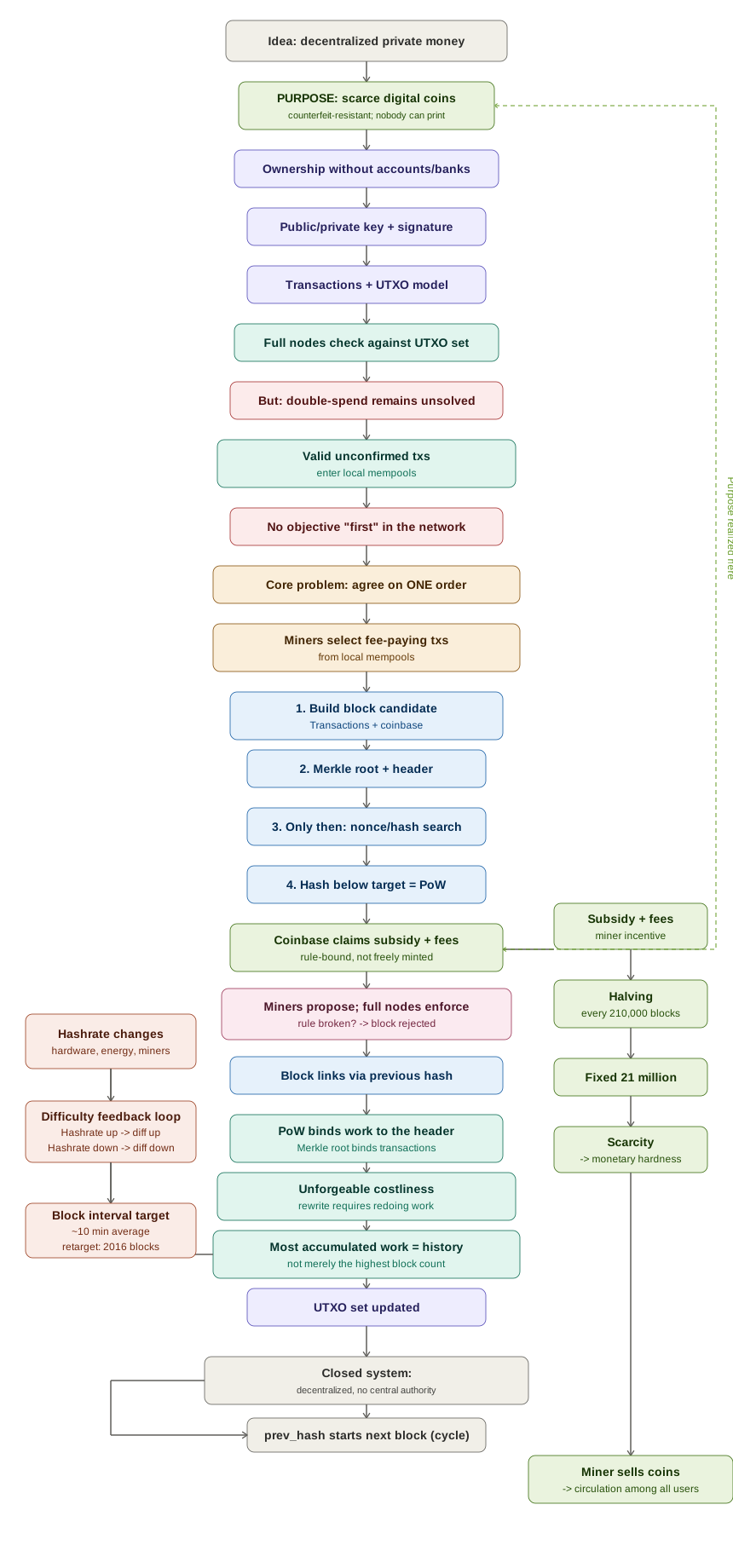
The six joints of that spine, named plainly:
Start with the ambition, not the ledger
The cleanest way to see Bitcoin is not as a ledger, but as a sequence of unsolved problems.
Start with the ambition: decentralized private money. Not private in the sense of perfect anonymity, and not decentralized as a slogan, but money that does not require a bank, issuer, clearinghouse, or central operator to decide who owns what and which payment counts.
The first problem is ownership. In the physical world, possession can carry evidence. A coin in your hand is hard to spend twice in two places at once. In the digital world, information copies naturally. A digital coin cannot merely be a file, because a file can be duplicated. The system needs a way to say: this person can spend this specific output, and other people can verify the authorization.
Public-key cryptography gives Bitcoin that first layer. A private key signs. A public key, or a condition derived from it, lets the network verify. The UTXO model makes the object of spending precise: not a mutable account balance, but discrete unspent outputs consumed and created by transactions.
That is already powerful. It removes the bank from the act of authorization. But it does not yet create money.
Signatures prove permission, not time
If Alice signs one transaction paying Bob and another paying Carol with the same output, each transaction may be valid when seen alone. The signature is correct. The referenced coin exists. The format obeys the rules. The conflict is not inside either transaction individually. The conflict is between them.
This is the first architectural hinge.
Digital signatures prove permission. They do not prove time.
And money needs time. It needs an order of events. It needs the world to agree that this spend came before that attempted double-spend, even though the network has no single clock, no single inbox, and no neutral observer watching every packet arrive.
This is where many descriptions of Bitcoin become too shallow. They jump from “transactions are signed” to “transactions are recorded on a blockchain” as if the chain itself solved the dispute. But a ledger records order after order has been selected. It cannot, by itself, explain who has the right to write the next line.
A competition inserted at exactly the right point
Satoshi’s design inserts a competition precisely where ordering breaks down.
Miners gather valid unconfirmed transactions from their local mempools. They choose a set. They include a coinbase transaction paying themselves the permitted subsidy and fees. They arrange the transactions, compute the Merkle root, place it in the block header, point the header to the previous block, and only then begin the nonce search.
The proof of work is therefore not generic computation. It is a cost attached to a specific ordering of transactions.
The miner chooses a candidate history first, then pays physics to make it hard to replace.
That line is the center of the architecture. Without it, proof of work would be a decorative expense. With it, proof of work becomes a public ordering mechanism. It turns many local views of the mempool into one costly proposed next state. (I pulled this single move apart on its own in First the Content, Then the Work — the order of operations is the whole trick.)
Proposal is not enforcement
Mining alone would be dangerous. If miners were the final authority, then whoever controlled enough hashpower could redefine money itself. They could inflate the supply, spend coins without signatures, or accept malformed transactions. The system would have replaced bankers with miners.
Bitcoin avoids that by separating proposal from enforcement. Miners propose blocks. Full nodes enforce rules.
A miner may build a block claiming more subsidy than allowed. The hash may be valid. The energy may be real. The block may even arrive quickly. None of that matters if the block violates the rules each full node independently checks. The network does not owe acceptance to work on invalid content.
Proof of work decides between valid histories. It does not make invalid history valid.
That asymmetry protects scarcity. The 21 million limit is not preserved because miners politely choose not to print more. It is preserved because nodes reject blocks that break the issuance rules. The coinbase transaction is permitted only within strict bounds: subsidy according to schedule, plus fees from included transactions. The miner receives newly issued coins, but he does not mint freely. The reward is therefore both incentive and constraint — it invites miners to secure the ordering process, while binding them to the monetary rules that make the coins worth securing.
Then comes the chain
Each block header points to the previous block. Each proof of work is bound to its own header. Each header commits to its transactions through the Merkle root. Change a past transaction and the Merkle root changes. Change the Merkle root and the header changes. Change the header and the proof of work no longer qualifies. To rewrite history, an attacker must redo the work for that block and every block after it, then outrun the honest network’s continuing work.
This is how Bitcoin manufactures a kind of irreversible time.
Not absolute finality. Not mathematical impossibility. A deep reorganization is not forbidden by logic. It is made economically and physically difficult. Bitcoin’s security is not a magic wall. It is an accumulating gradient of cost. The longer a transaction sits under new blocks, the more work has accumulated above the history that contains it. The system does not say, “This can never be changed.” It says, “Changing this now requires replacing the most costly public history and continuing faster than everyone extending it.”
That is weaker than metaphysical certainty.
It is stronger than administrative promise.
The phrase “most accumulated work” matters here. Bitcoin does not simply follow the chain with the highest number of blocks. It follows the valid chain with the greatest total proof of work. This distinction prevents a cheap series of easy blocks from masquerading as stronger history. What counts is not length as appearance, but cost as structure.
The feedback loops
Now add the loops that keep the machine from drifting.
Hashrate changes. Miners enter and leave. Hardware improves. Energy prices move. Geography shifts. If block production were left alone, the monetary clock would speed up whenever hashpower rose and slow down whenever hashpower fell. That would make issuance unstable and settlement cadence unpredictable.
Satoshi’s design closes this gap with difficulty adjustment. Roughly every 2016 blocks, the network recalibrates the target so blocks tend back toward a ten-minute average. Hashrate goes up, difficulty rises. Hashrate goes down, difficulty falls. The system does not need a committee to maintain its rhythm. It measures its own recent output and changes the constraint.
This is not cosmetic. It connects security, issuance, and time. The subsidy schedule is expressed in blocks, not board meetings. The halving occurs every 210,000 blocks. The total supply approaches 21 million because the issuance rule is predetermined and enforced by nodes. The block interval target gives that schedule a rough relationship to human time, while the difficulty adjustment keeps the relationship from being captured by raw increases in computation.
Scarcity, then, is not a number pasted onto the system. It emerges from the interaction of rules, validation, incentives, proof of work, and feedback.
The same is true of circulation. Miners earn subsidy and fees, but their costs are external — hardware, electricity, facilities, operations, financing. To continue, many miners sell some coins. The reward therefore does not merely secure the chain; it also moves newly issued coins outward into the market. The system pays for ordering by creating coins according to rule, then lets economic pressure distribute them.
None of these pieces is sufficient alone
That is the point worth holding onto:
- Keys without ordering produce signed conflicts.
- Ordering without validation produces miner sovereignty.
- Validation without incentives produces no open competition to write history.
- Incentives without scarcity produce inflation.
- Scarcity without difficulty adjustment loses temporal calibration.
- Blocks without previous hashes produce isolated records.
- Hashes without economic cost produce cheap assertions.
Satoshi’s achievement was architectural placement. He did not remove trust by finding one perfect component. He removed the need for a central operator by making imperfect components constrain one another. This is the same instinct behind a Symbiostate: order that holds because the parts check each other, not because someone sits at the top enforcing it.
Three readings of the same structure
What it says. Bitcoin is a causal chain in which signatures define spend authority, nodes enforce validity, miners propose transaction order, proof of work makes that order costly, previous hashes link history, difficulty stabilizes timing, and the issuance schedule creates scarcity.
What it implies. No single component is Bitcoin. The system works because each part answers a specific failure mode left open by the part before it. The design is not modular in the casual sense. It is interlocked.
What it means operationally. When judging Bitcoin, do not ask whether one element sounds strange in isolation. Ask what problem that element solves in the chain. Energy, blocks, halvings, mempools, full nodes, and UTXOs are not separate trivia. They are the load paths of the structure.
Decision altitude
Flight Log — Dispatch from Altitude
An aircraft is not made airworthy by one brilliant part.
The engine matters. So do the wings, control surfaces, fuel system, instruments, electrical buses, maintenance intervals, checklists, and the pilot’s authority to reject a takeoff when a parameter is wrong. Remove any one of the load-bearing connections and the machine may still look like an aircraft, but the architecture has changed.
The important thing is not that the components exist. It is that they are connected in the right order. Fuel does not help if it cannot reach the engine. Thrust does not help if the aircraft is not configured. Instruments do not help if no one is obliged to respect their limits. A checklist is not bureaucracy. It is a causal sequence designed to prevent one missing condition from becoming a catastrophe.
Bitcoin has the same character. Keys authorize spending. UTXOs define what is being spent. Nodes check the rules. Miners assemble a candidate next state. Proof of work applies thrust to that specific state. Previous hashes put the aircraft on a continuous route instead of isolated hops. Difficulty adjustment trims the system against changing atmospheric conditions. The reward schedule supplies fuel without letting the pilot invent more fuel midair.
Seen from outside, some of this looks excessive. Why all the hashing? Why the ten-minute rhythm? Why the chain of headers? Why the halving? Why make every full node check what miners already worked on?
Because the system has no tower.
There is no central controller sequencing arrivals, clearing departures, correcting the clock, authorizing fuel, and declaring which aircraft owns the runway. Satoshi’s design replaces that tower with a set of local rules whose combined effect is global order. Every part carries a specific absence:
- No bank, so signatures.
- No account master, so UTXOs.
- No global first, so proof-of-work ordering.
- No miner sovereignty, so full-node enforcement.
- No stable hashpower, so difficulty adjustment.
- No issuer discretion, so halving and fixed supply.
- No central history, so accumulated work.
That is the architecture of Bitcoin. Not a machine ruled from above, but a machine that keeps becoming itself from below.