The claim arrives from every direction. Conference keynotes. LinkedIn posts. Venture capital pitch decks. Newspaper columns. It comes in various intensities — from the cautious (“AI will significantly disrupt the labour market within a decade”) to the apocalyptic (“80% of knowledge jobs will be gone in five years”) — but the underlying assumption is always the same: the software is ready, the capability is proven, and the transformation is a matter of adoption, not infrastructure.
This assumption is wrong. Not wrong in degree. Wrong in kind. It confuses a software capability with a deployable system. A large language model that can pass a bar exam on a single GPU is not the same thing as a system that can replace 1.75 billion knowledge workers simultaneously. The difference between the two is not software. It is hardware, energy, and time. And when you do the arithmetic, the numbers are not close.
The Token Arithmetic
Start with the demand side. There are approximately 3.5 billion workers on Earth. A conservative estimate puts 1.75 billion of them in knowledge work — analysis, communication, decision-making, administration, information processing — the categories most directly addressable by LLMs. A typical knowledge worker’s daily output requires at minimum 200,000 tokens of AI processing once you account for input context, chain-of-thought reasoning, and generated output. Complex analytical, legal, or medical work often requires millions.
Now the supply side. Global AI inference capacity is an estimated 5–10 million H100-equivalent GPUs, not all dedicated to inference. One H100 generates roughly 2,000 output tokens per second at frontier scale with batching.
- Demand: 1.75 billion workers × 200,000 tokens = ~350 quadrillion tokens/day
- Supply: 10 million GPUs × 2,000 tokens/sec × 86,400 sec = ~1.7 quadrillion tokens/day
- The gap: a factor of 200x
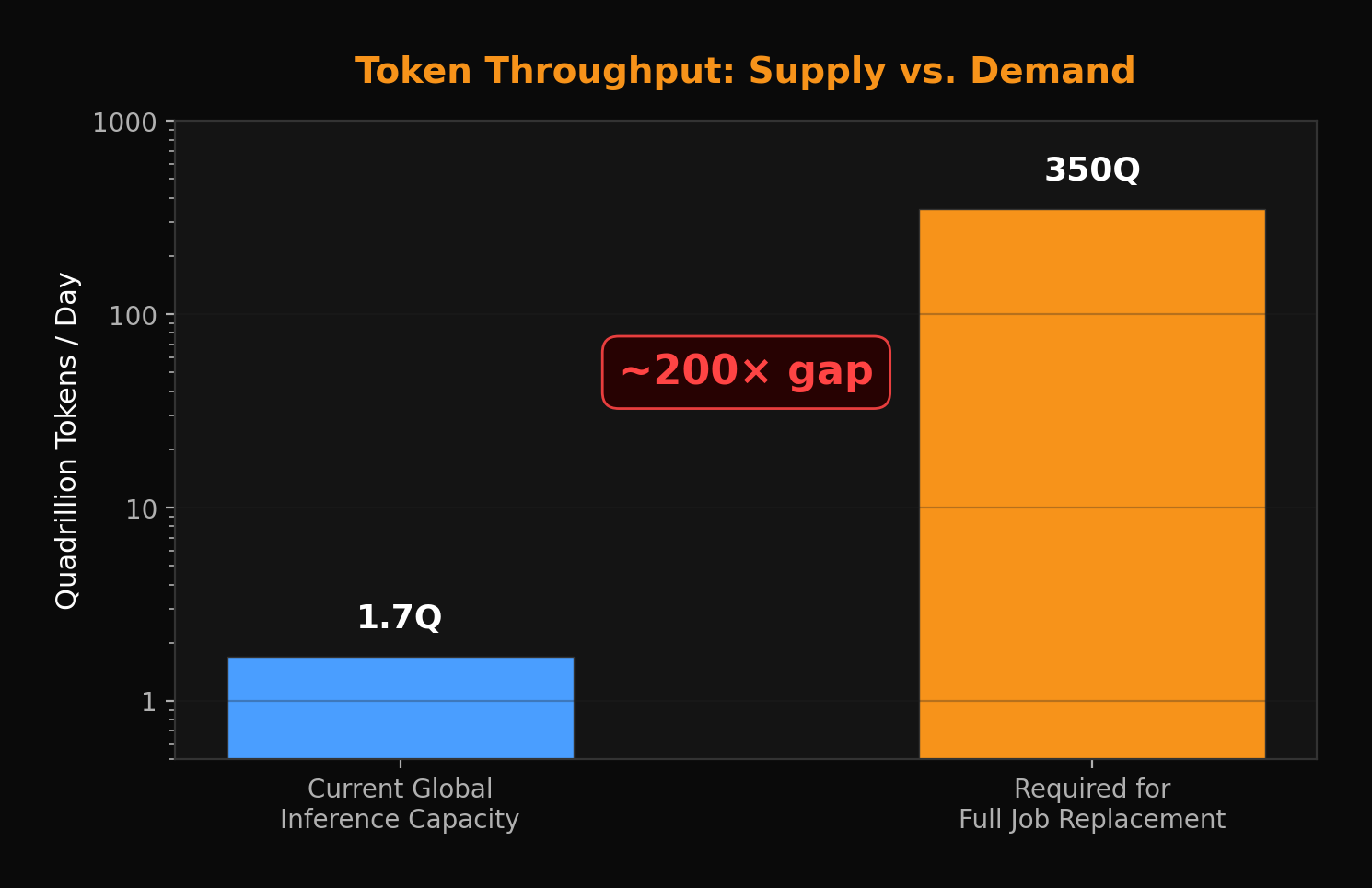
Read that ratio again. Current global GPU infrastructure can serve less than one-half of one percent of the compute required for full knowledge-worker replacement. Not 50%. Not 5%. Half a percent.
And this calculation is generous. It assumes every inference GPU on Earth runs at maximum throughput, 24 hours a day, with no downtime, no training workloads, and no network overhead. It ignores that frontier models — the ones actually capable of complex reasoning — consume 10 to 50 times more compute per token than the small, fast models used for simple tasks. The real gap for frontier-level work is not 200x. It is potentially thousands of times.
The Energy Wall
Now translate the GPU gap into energy. An Nvidia H100 draws roughly 700 watts under inference load. With cooling, networking, and storage overhead at a Power Usage Effectiveness of 1.3, the effective draw is about 900 watts per GPU.
- Current AI inference: ~9 GW (10M GPUs × 900W)
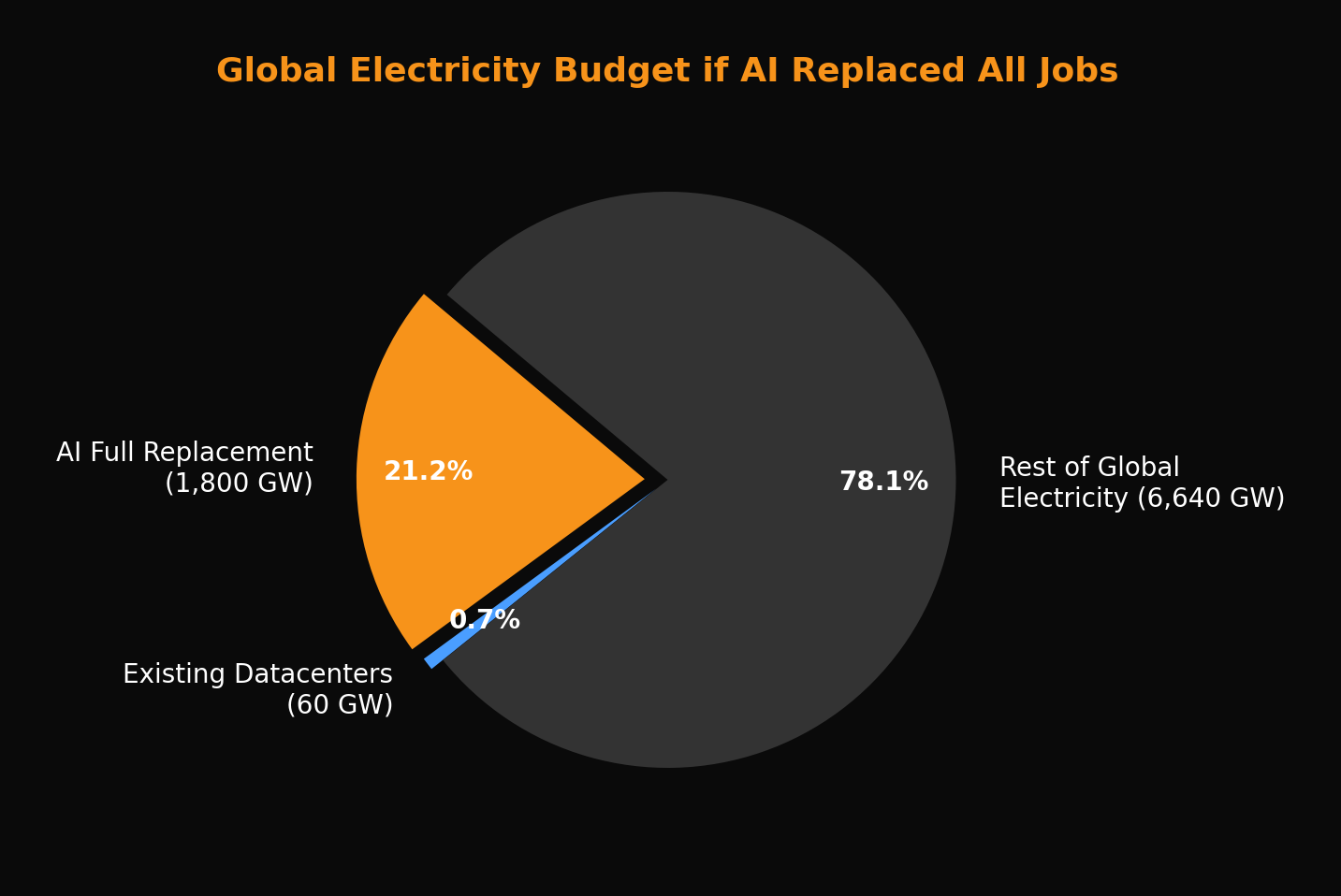
- Required at 200x: 1,800 GW = 1.8 terawatts, continuous
- Global average electricity production: ~3.5 TW → AI would consume ~21% of all electricity on Earth
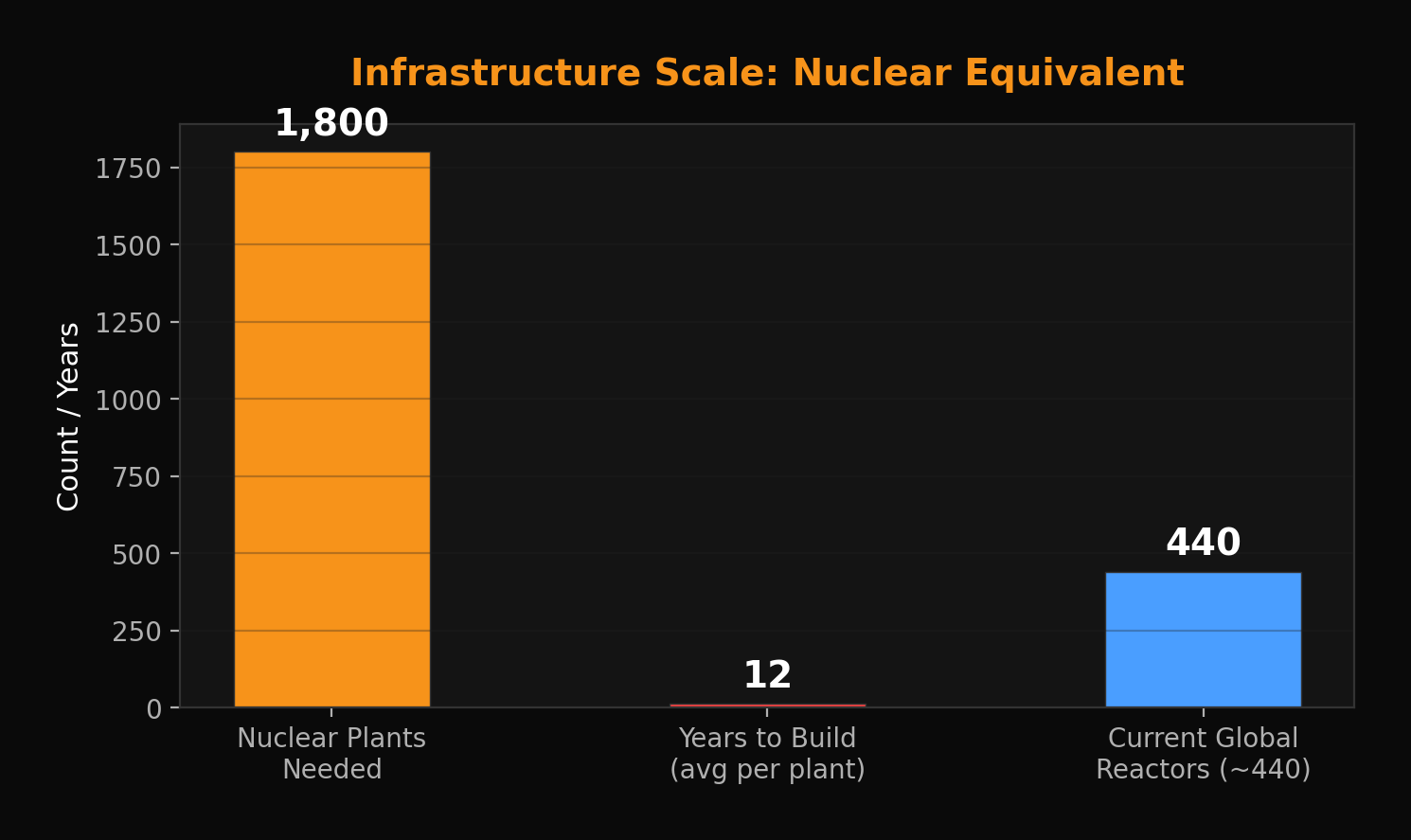
- Equivalent to ~1,800 nuclear reactors, each taking 10–15 years to build
- Today’s entire global data-centre capacity: 50–70 GW → a 25–36x expansion required
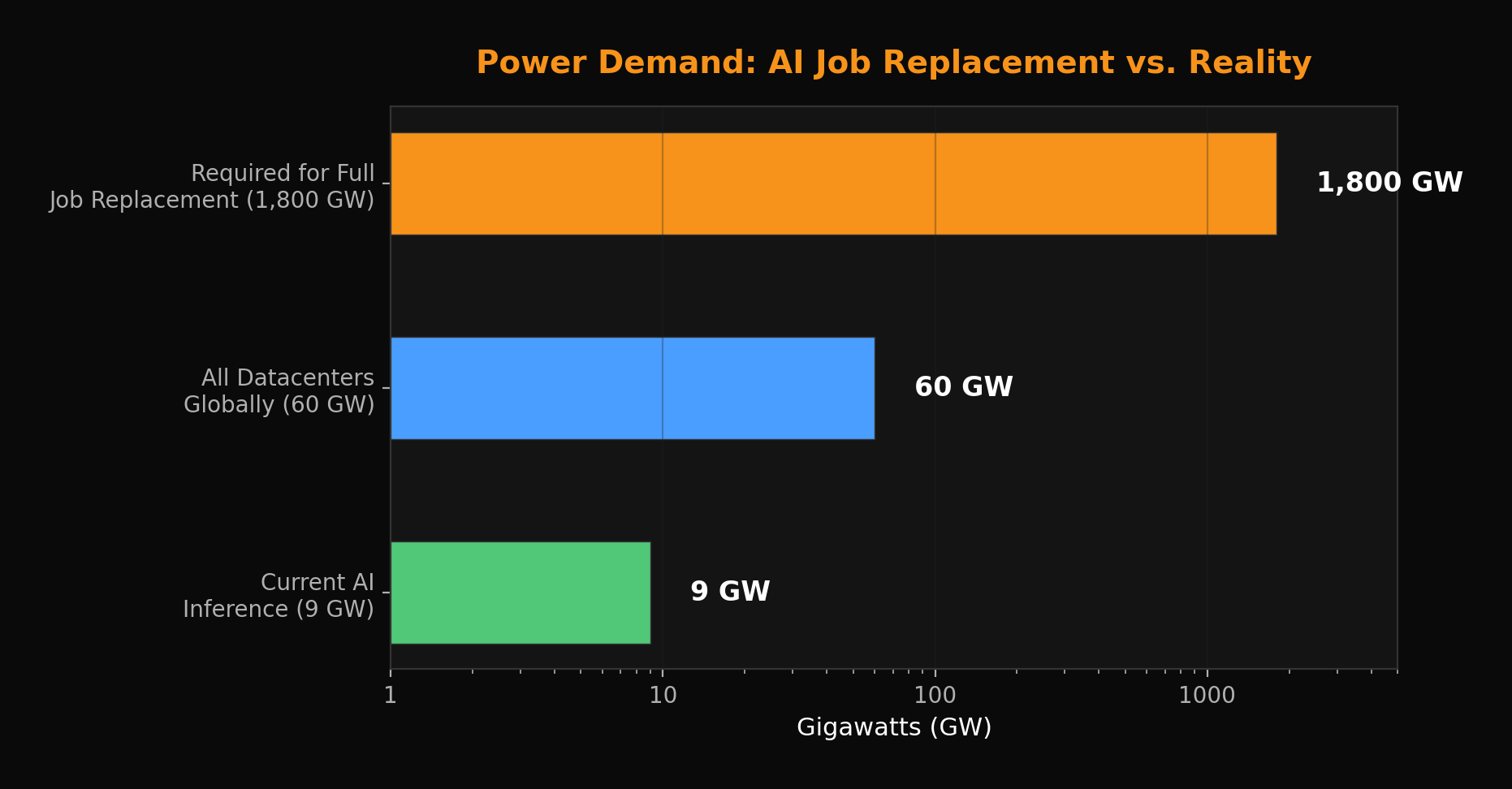
The “five years, 80% of jobs gone” thesis does not fail at software. It fails at physics, copper, silicon, uranium, and concrete.
And this is only inference. Training the next generation of frontier models comes on top — hundreds of megawatts per run today, potentially hundreds of additional gigawatts at scale.
The Time Constraint
Even if the capital were available — and it would need to be in the trillions — the physical infrastructure cannot be built fast enough. The constraints are layered and compounding.
- New TSMC fab: 3–5 years from decision to production
- Chip production doubling time: 3–4 years, at best
- Large data centre: 18–36 months
- Nuclear power plant: 10–15 years
- At a realistic 20% annual GPU growth: ~28 years to close the 200x gap (1.2²⁸ ≈ 197)
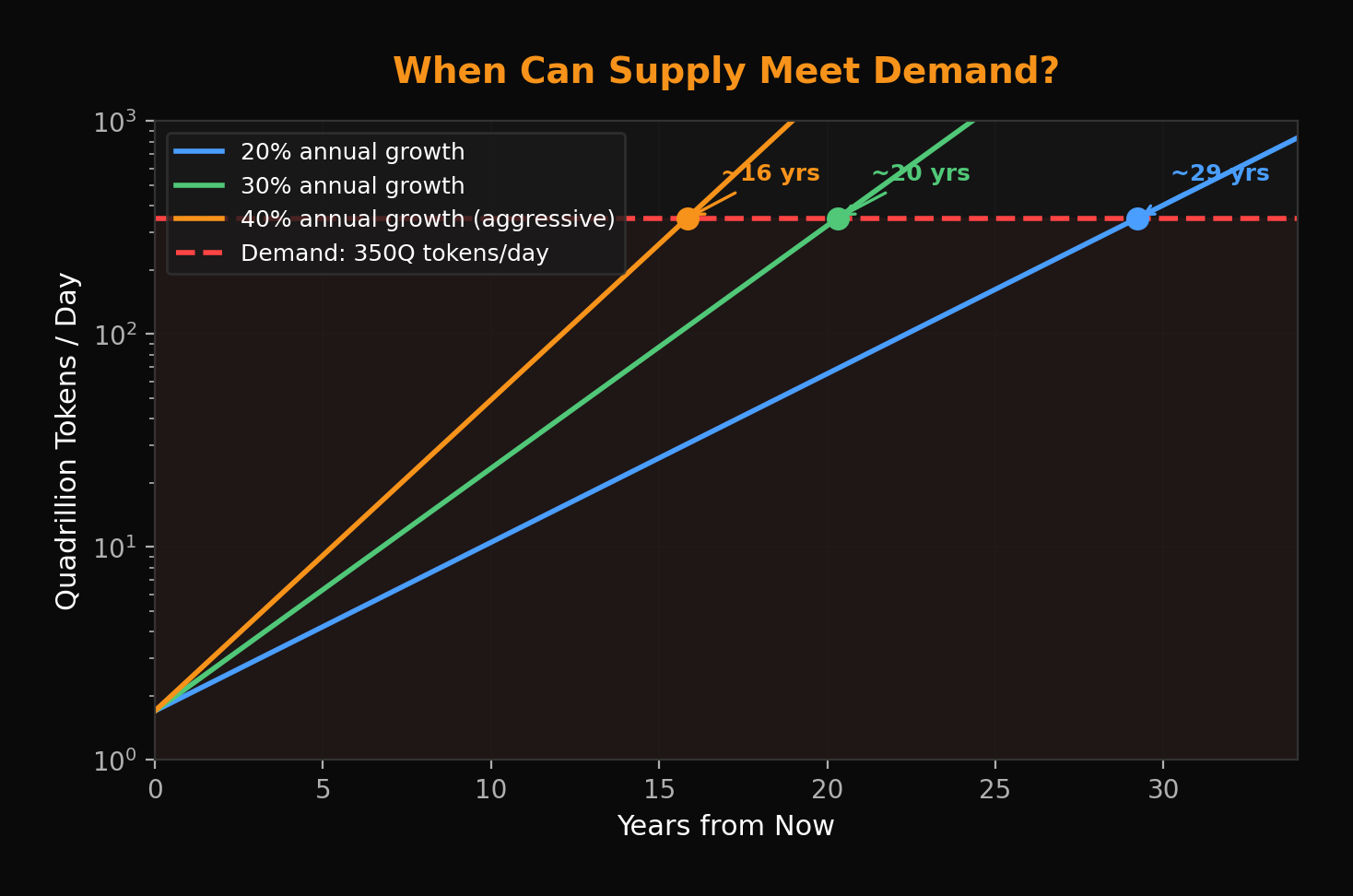
Even at an unprecedented 30% growth it takes 20 years; at a physically implausible 50% it still takes 13. The “five years” claim is not pessimistic or optimistic. It is arithmetically impossible.
What This Actually Means
None of this means AI will not transform work. It will. It already is. But the transformation will be selective, gradual, and constrained by physical infrastructure at every step. The pattern will not be “80% of jobs disappear in five years.” It will be: AI augments the most compute-efficient tasks first — text generation, code assistance, summarisation, translation — and slowly expands into more complex work as infrastructure scales over decades.
The scarce resource is not intelligence. The models are already intelligent enough to perform a remarkable range of tasks. The scarce resource is watts per token per second at planetary scale. And that scarcity is governed by the same physical constraints that govern every other infrastructure buildout in history: the speed at which you can mine materials, fabricate components, build facilities, and generate power.
AI is not a software revolution that happens at software speed. It is an infrastructure revolution that happens at infrastructure speed. And infrastructure speed is measured in years, not quarters. (The deeper thermodynamic case — why energy, not code, is the binding constraint — is in Wealth Is Energy.)
Flight Log — Dispatch from Altitude
The A320 can, in theory, fly itself. The autopilot, the autothrust, the flight management system — taken together, they can manage every phase of flight from takeoff to landing. The software capability exists. It has existed for decades. And yet every commercial aircraft on Earth carries two pilots. Not one. Two.
The reason is not that the software is not good enough. The reason is that the infrastructure required for fully autonomous commercial flight — the regulatory framework, the redundancy architecture, the ground-based monitoring, the public trust, the certification process — does not exist yet. The A320’s autopilot proved the concept in the 1980s. Forty years later, every flight still has two humans in the front.
AI and jobs follow the same pattern. The models have proved the concept. They can write code, draft contracts, analyse data, generate reports. The capability is real. But the infrastructure required to deploy that capability at the scale of the global workforce does not exist. It will be built. It will take decades. In the meantime, AI will do what the autopilot has done for forty years: augment the human, handle the routine, and leave the complex decisions to the person in the seat.
The people who say “80% of jobs gone in five years” are looking at the autopilot and concluding that pilots are obsolete. They are confusing a demonstration with a deployment. They are confusing what a system can do with what a civilisation can build.
The autopilot can fly the plane. The pilots are still here. The math explains why. And for AI and jobs, the math is the same.