Anti-entropy through design. Exploring the convergence of money, consciousness, politics, and technology — building the architecture for what comes next.
“… before venturing into more complex ideas.”
Research briefs, modern websites, and small custom tools — built with AI by someone who uses it in real production every day: two published books, two apps in the stores, this site. No agency overhead, no buzzwords.
Für Betriebe in Köln, Leverkusen und Umgebung: Website, Flyer und Prospekte, Fachrecherche zu Gesetzen und Fördermitteln, kleine Werkzeuge für die Kundengewinnung — keine Agentur, ehrliche Einschätzung, Festpreis nach Absprache.
Available Mehr erfahren / Learn more → Contact →
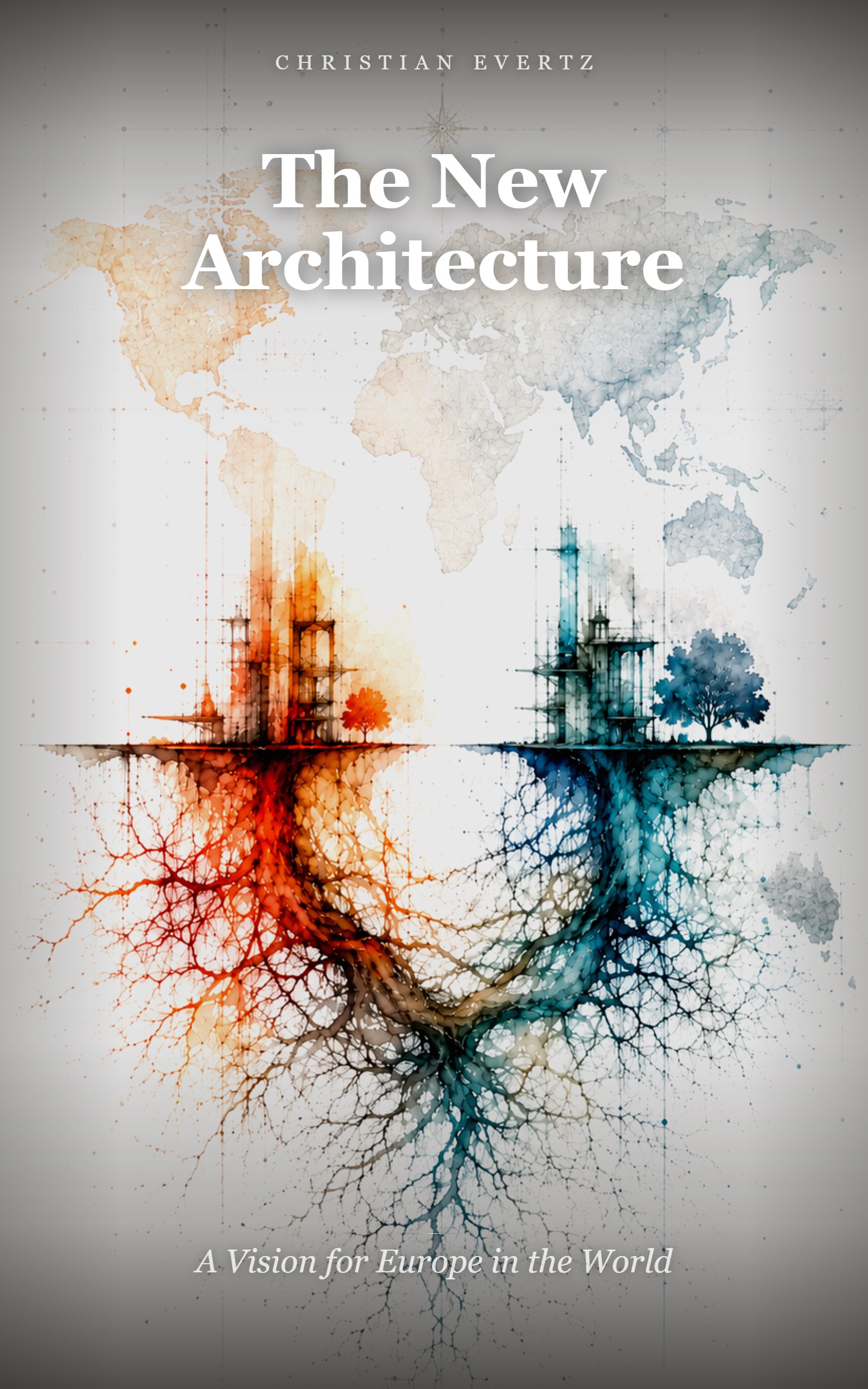
Negentropy PressA diagnosis, a vision, and a vocabulary for the next architecture of political organization.
Every building that has ever collapsed was, at some point, considered sound. The people inside it were not the problem. The design was the problem — a flaw in the load-bearing structure that no amount of good behaviour by the occupants could compensate for. Political systems fail the same way. Not because the people inside them are corrupt or incompetent, but because the architecture — the way power is distributed, the way decisions produce consequences, the way accountability is routed — is no longer adequate for the forces it must bear.
Written by an airline captain of twenty-six years — a profession built on managing complex systems under real-world constraints — it brings the outside observer's perspective to political theory: that of someone who has had to understand the systems he operates, not as an ideologue but as someone responsible for outcomes.
Identifies a single mechanism — the loop — operating across democratic societies: concentrated decision-making, diffused consequences, absent accountability, cognitive retreat, reform blockade. It traces the neurology of tribalism and resolves the central paradox of reform: if the problem is built into the system, the solution must be too. The resolution is architectural: design comes first; cognitive recovery follows.
Focuses on Europe — a continent of 500 million people in liberal democracies that possesses everything it needs to lead and acts as though it has nothing. It diagnoses the permission trap: an institutional setup that produces passivity by design. It then sketches a concrete architecture — a technology sovereignty fund, a defense union, a foreign policy core group, an accountability framework — implementable through existing Treaty provisions (Articles 326–334 TFEU), without unanimity, within the window that remains.
Proposes a new form of statehood: the Symbiostate, defined by shared values, economic complementarity, and strategic congruence rather than geographic proximity. Governed through an information architecture built on Shannon's information theory, Bayesian institutional learning, Proof of Work accountability, and Kelly-calibrated commitment. Tested against three real-world pairings — Germany and Canada, the Anglosphere, India and Botswana — and defended against the strongest objections its critics would raise.
This book is not addressed to parties, institutions, or ideologues. It is addressed to people who refuse to trade complex reality for group identity. Who understand that the defining problems of our time are systemic — and that systemic problems require systemic answers.

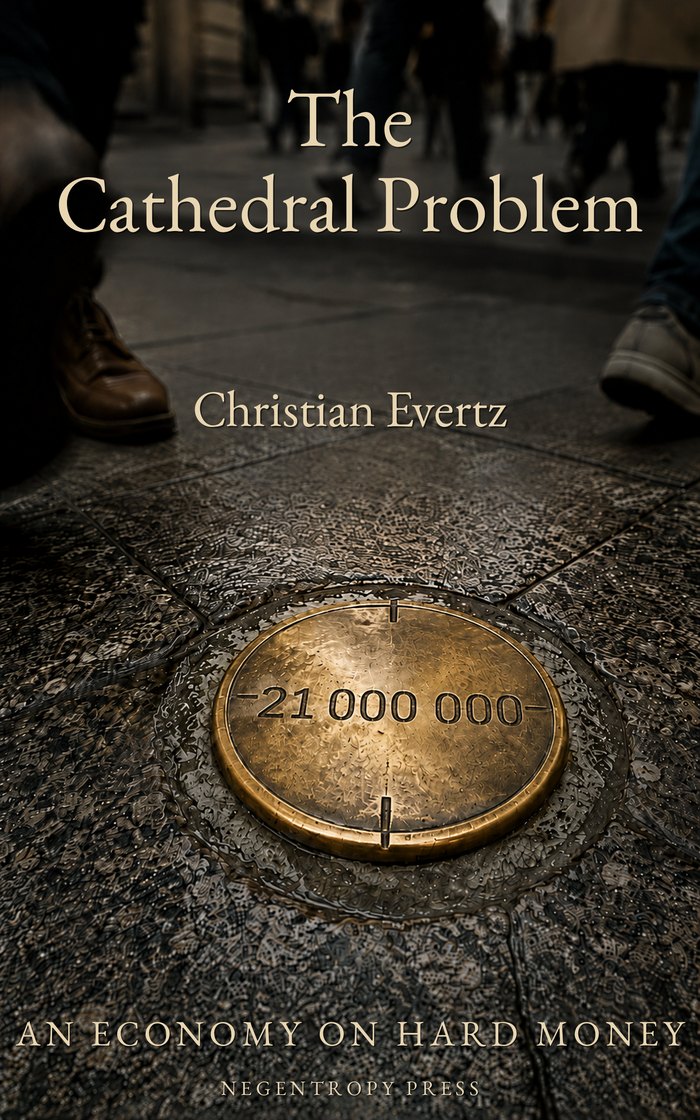
Negentropy PressMost Bitcoin books argue that hard money wins. This one begins the morning after it already has.
If Bitcoin becomes the base layer of a post-fiat economy, what gets built on top of it? Not the price in dollars, but the actual architecture of daily life: what a coffee costs in sats and why, how a mortgage works when the unit only gets scarcer, what a pension holds, how a bank issues credit against a reserve it cannot print, how a state finances itself when it can no longer quietly inflate. The Cathedral Problem takes the altar — Bitcoin, fixed and finished — as given, and asks the harder question of the cathedral that has to be raised around it.
It is an engineer's book more than an evangelist's. Prices come in bands, not false points. Every scenario carries its own failure modes. Four intellectual traditions — Austrian hard money, free banking, cypherpunk cryptography, and the credit theory of Graeber and Polanyi — are held in tension rather than played against each other. And where the synthesis is genuinely unfinished, the book says so instead of pretending otherwise. It is closer in spirit to Hayek's Denationalisation of Money than to the usual triumphalism: a serious sketch of a world that does not yet exist, drawn with numbers and with honesty about what those numbers can and cannot carry.
For readers who already know why Bitcoin matters and want to think clearly about what comes next.
GET THE BOOK
Negentropy PressAls Kind hatte ich Angst vor etwas, das ich damals nicht benennen konnte: dass es aus der Existenz als Ganzer keinen Ausgang gibt.
Ein unendliches Universum bedeutete für mich Gefangenschaft. Ein endliches war keinen Deut besser — denn was jenseits seiner Grenze läge, wäre ja wieder kein echtes Draußen. Auch Tod, Jenseits oder Gott waren für mich nie ein Ausweg, sondern nur weitere Räume innerhalb des Seins. Es gab keine Tür, die irgendwohin geführt hätte.
Heute, mit 49, macht mir dieser Gedanke keine Panik mehr. In diesem Essay schaue ich zurück: zuerst persönlich, auf ein Kind, das nachts wach lag — dann im Gespräch mit denen, die vor mir in derselben Sache standen: Leibniz, Spinoza, Levinas, Mainländer und andere. Ich suche dabei keine Tür. Dass es keinen Ausgang gibt, ist für mich der Ausgangspunkt, nicht die offene Frage.
Was mich stattdessen interessiert: Was verrät diese Einsicht über Unendlichkeit, über das Nichts, über Gott, über Bewusstsein — und über unser hartnäckiges Bedürfnis nach Trost? Am Ende ist das Rätsel nicht gelöst. Verändert hat sich nur die Macht, die es über mich hat.
Dieser Essay ist aus dem Blogbeitrag The Doorless Room hervorgegangen, der dieselbe Frage an sieben Denkern durchspielt — das Buch ist die persönliche Geschichte dahinter. English edition below.
GET THE BOOK
Negentropy PressAs a child, I was afraid of something I could not yet name: that there is no exit from existence as a whole.
An infinite universe meant captivity to me. A finite one was no better — whatever lay beyond its boundary would not have been a true outside either. Death, an afterlife, God were never a way out in my eyes, only further rooms within being. There was no door that led anywhere.
Today, at 49, the thought no longer panics me. In this essay I look back: first personally, at a child lying awake at night — then in conversation with those who stood before the same wall long before me: Leibniz, Spinoza, Levinas, Mainländer and others. I am not searching for a door. That there is no exit is my starting point, not my open question.
What interests me instead: what does this insight reveal about infinity, about nothingness, about God, about consciousness — and about our stubborn need for consolation? In the end, the riddle is not solved. What has changed is only the power it holds over me.
This essay grew out of the blog post The Doorless Room, which walks the same question past seven thinkers — the book is the personal account behind it. Deutsche Ausgabe oben.
GET THE BOOKTwo books on the architecture of what comes next — one on the political order, one on the monetary one. Both written from the outside observer's seat.
LiveA diagnosis of the loop that disables democratic reform, and a concrete architecture for the continent that could still lead.
Get the book →Begins the morning after hard money has won, and asks what actually gets built on top of it.
Get the book →A personal essay on a childhood fear that existence as a whole has no exit — and what that insight reveals about infinity, God, consciousness, and consolation.

Deutsche Ausgabe → English edition →Two tools built on the same principle: your data stays on your device. No account, no cloud, no tracking, no ads.
LiveA contemplative companion for pantheist thought. Daily reflections, guided awareness, and a map of awe — designed to reconnect you with the sacred in the ordinary.
App Store → Google Play →A fast, private calorie and weight tracker. Log food, see your daily budget, macros and weight trend — everything stored on your device.
App Store → About the app →Dispatches from the intersection of AI, Bitcoin, and emerging technology. Written at altitude — clarity above the noise.
Live Read the blog →Two independent syntheses of the same unresolved question — why sleep exists as a distinct state — built in parallel with two different AI research assistants, arriving at different answers. Free to download, free to attack.
Preprints · Not peer reviewedSeparates three routinely fused questions — what sleep is for, when it becomes indispensable, where it came from — and answers each against a curated evidence register of 109 entries and 294 sources. Puts forward one deliberately falsifiable thesis carrying three pre-committed kill criteria. Same paper in two typesettings.
Journal layout, 15 p. (PDF) → Preprint layout, 26 p. (PDF) →The parallel study, run with a different assistant — and a different result. It splits the problem into four questions (what counts as sleep, how wake history is regulated, which operations truly depend on the sleep mode, how its components evolved), audits the evidence through a typed causal framework, and rejects the inference that maintenance, learning or replay require global sleep — without establishing that sleep is replaceable. Where the first paper builds a thesis, this one builds the discipline for testing any such thesis, and adopts the window thesis only in narrowed form.
Preprint, 26 p. (PDF) →
Independent publishing for ideas that refuse simplification. Where complex reality meets clear prose.
Active What is negentropy? →Dispatches from the intersection of AI, Bitcoin, and emerging technology. Written at altitude — clarity above the noise.